

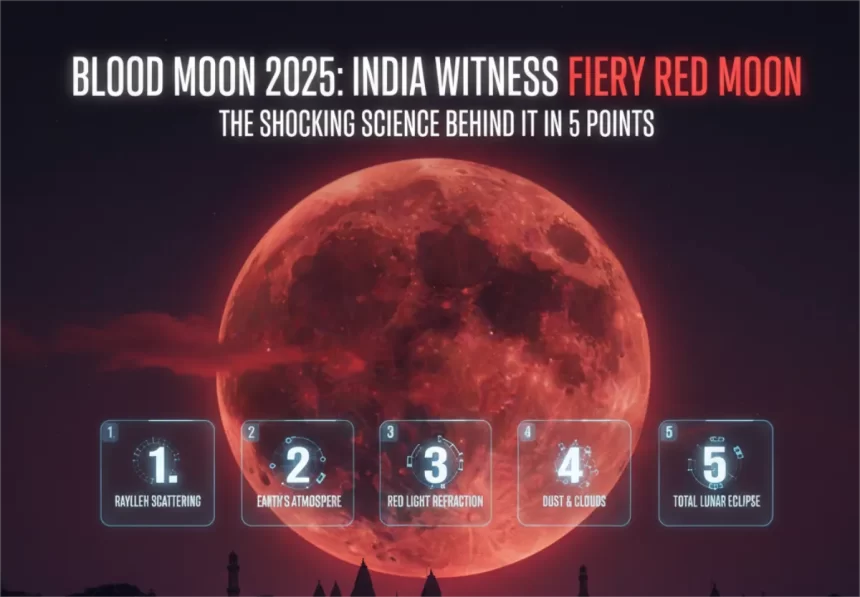
On Sunday night, September 7, 2025, millions of people across Asia, Australia, and parts of Africa were treated to a breathtaking celestial spectacle. At around 9 PM IST, the Moon dramatically turned blood red during a total lunar eclipse. Across India, skywatchers stood amazed as Earth’s shadow slowly consumed the Moon, creating a jaw-dropping “Blood Moon.”
Why does the Moon turn red instead of disappearing? What does this rare event reveal about our atmosphere? And why do scientists get so excited about it? Here’s everything you need to know, explained in 5 quick points:
1. What Exactly Is a Lunar Eclipse?
A lunar eclipse occurs when Earth slips directly between the Sun and the Moon, blocking sunlight from reaching the Moon. If Earth’s shadow completely covers it, it’s a total eclipse; if only partly, it’s a partial eclipse.

2. Why Does the Moon Turn Blood Red?
Instead of vanishing, the Moon glows red because Earth’s atmosphere bends sunlight around it. As the light passes through, blue light scatters away while only red light reaches the Moon—painting it in a fiery crimson shade.
3. What the Red Color Tells Us About Earth
The shade of red actually reveals the state of our planet’s atmosphere. More pollution, volcanic ash, or dust = darker, deeper red. In fact, a 2023 University of Geneva study used medieval eclipse records to connect unusually dark Blood Moons to volcanic eruptions centuries ago.
4. The Link Between Blood Moon and Sunsets
The same science behind a Blood Moon also explains why skies are blue and sunsets are red. Known as Rayleigh scattering, it occurs because shorter blue wavelengths scatter more, making the daytime sky blue. During sunset (and lunar eclipses), sunlight travels longer through the atmosphere—leaving behind rich reds and oranges.

5. How It Looked in India
For India, here were the exact timings (IST):
- 8:58 PM, Sept 7: Penumbral eclipse begins
- 9:57 PM: Partial eclipse begins
- 11:00 PM: Total eclipse (Blood Moon) begins
- 11:41 PM: Peak eclipse
- 12:22 AM, Sept 8: Total eclipse ends
- 1:26 AM: Partial eclipse ends
- 2:25 AM: Penumbral eclipse ends
No telescopes were needed—just a clear sky. From rooftops and open fields, Indians witnessed the Moon glowing blood red, making it one of 2025’s most unforgettable sky events.
👉 This Blood Moon wasn’t just a cosmic show—it’s a reminder of how Earth’s atmosphere shapes the universe we see.